Upholding Sustainability at UNC Charlotte
Britt Olson digs into UNC Charlotte’s approach to sustainability. With insights from recently retired campus Sustainability Officer Dr. Mike Lizotte, she traces how sustainability initiatives are woven into campus life, the balancing act required across competing priorities, and the unique challenges these initiatives face at public universities.
On my first day at the “Infusing Sustainability into Curriculum” workshop, I walked into the brightly lit classroom feeling like a kid again. A back-pack slung over one shoulder (like my cool students), a pencil pouch full of earth-toned highlighters, and my carefully chosen leaf-patterned notebook. The Sustainability staff had thoughtfully provided snacks and some much-needed tea and coffee. We wore handwritten name tags, picked at blueberry muffins, and talked freely about the joys and challenges of teaching in the tech age. The air was full of excitement as we prepared to add some fresh perspective and pedagogy to our upcoming fall courses.
I expected to learn about which native plant species were being planted in the Botanical Gardens, or the best books to teach in an environmental literature class. Instead, our campus Sustainability Officer, Dr. Mike Lizotte, and the rest of the sustainability team swiftly taught me the first lesson of sustainability: the ‘hot takes’ and inspiring innovations we often associate with sustainability work are just the tip of the iceberg; far beneath are the nuanced, pragmatic frameworks and devoted people that make sustainable action possible.
Dr. Lizotte shared integral pieces of his nearly 20 years’ worth of sustainability wisdom with my cohort, including introducing us to Kate Raworth’s Doughnut Economics and the Nested Model of Sustainability. Two foundational sustainability theories that we learned about in our workshop. I was curious:
How are universities operationalizing sustainability, and what can we learn from them?
Theoretical Frameworks
While defining sustainability for the cohort, Dr. Lizotte’s team discussed several key figures and theories that any aspiring sustainability trainees should know. They opened the workshop with a discussion of the “triple bottom line theory.” Sometimes referred to as the three E’s: Environment, Economy, Equity, or the three P’s: People, Planet, Profit.
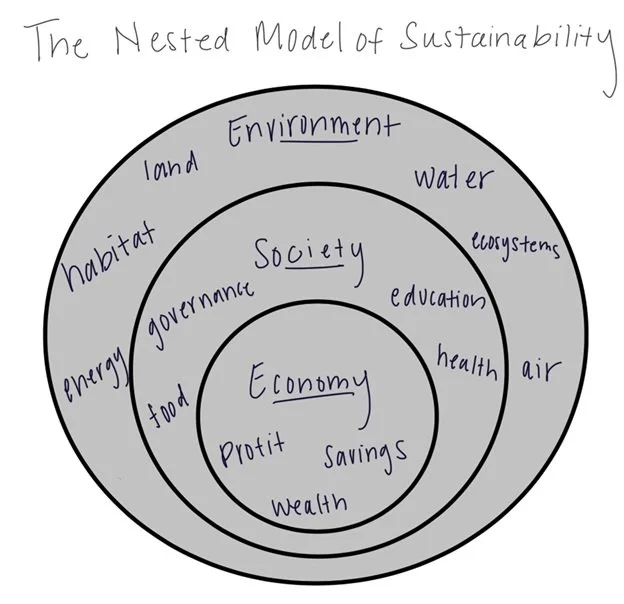
The triple bottom line theory is used to outline the interwoven nature of social, economic, and environmental sectors of sustainability. This broadened approach is important for laypeople to truly capture the complexity of sustainable business choices.
When profit climbs, people and the planet often suffer. When people overconsume, our physical environments are picked clean of vital resources.
A holistic understanding of sustainability is the foundation required for operationalizing this kind of work in any business setting, including universities.
Economist Kate Raworth’s ‘doughnut’ visual offers a model with which we can conceptualize the correlative relationships between our social and ecological boundaries.
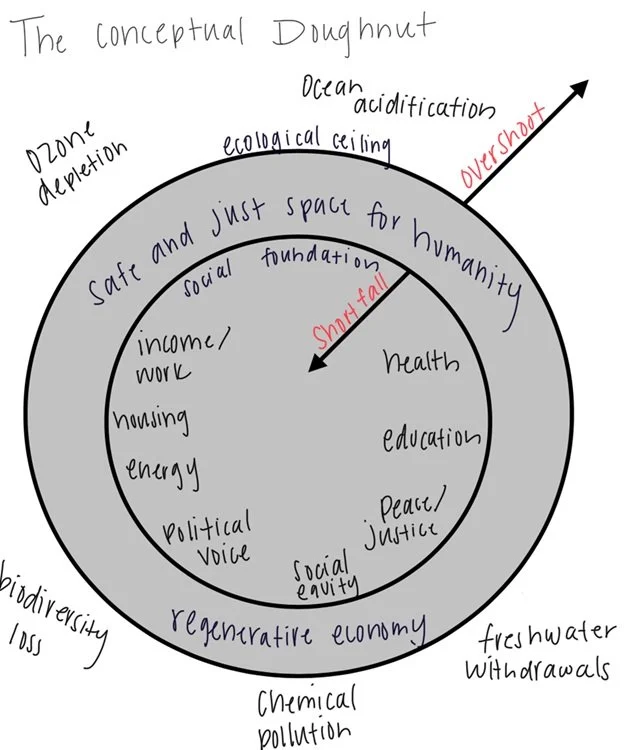
“The doughnut’s environmental ceiling consists of nine planetary boundaries, as set out by Rockstrom et al. (2009), beyond which lie unacceptable environmental degradation and potential tipping points in Earth systems. The twelve dimensions of the social foundation are derived from internationally agreed minimum social standards, as identified by the world’s governments in the Sustainable Development Goals in 2015. Between social and planetary boundaries lies an environmentally safe and socially just space in which humanity can thrive” (Raworth).
Raworth created the doughnut model to help individuals and organizations move towards a regenerative and distributive economy where human needs can be met without unnecessary environmental degradation. Universities are making sustainability-related decisions every day, and have a direct impact on the movement of “the doughnut.”
For example, by offering adequate healthcare services or defending intellectual freedom on campus, universities can create an essential foundation of social safety and well-being. From this more secure platform, university stakeholders can engage in more open and considerate dialogue around important issues, including environmental concerns. Where humans are nurtured and protected, sustainability work can thrive inclusively and intentionally.
Understanding Sustainability at UNC Charlotte
Much like his curriculum workshop, during an interview, Dr. Lizotte reiterated the importance of a holistic approach to university sustainability work, like the triple bottom line approach. To Dr. Lizotte, sustainability at UNC Charlotte works as “an expansion of concerns,” where financial sustainability practices are expanded to include the university’s social and environmental concerns.
In his experience at UNC Charlotte, sustainability starts with facilities, “utility bills and, literally, the housekeeping of a university.” These seemingly mundane activities are more critical to the sustainability goals of an urban campus like UNCC, relative to the natural ecosystems preservation and management that many people may associate with sustainability. Where human needs like education and housing are the priority, universities like Charlotte find entry-points into sustainability opportunities by diving deep into facilities management, to see what can work better, run smoother, and where support is needed.
While Dr. Lizotte and others in the sustainability office pointedly admire the work of other public universities, like New York’s SUNY College of Environmental Science and Forestry (ESF), for their dedication to natural spaces, top-of-the-line environmental laboratories, field work, and more, the realities of working within an urban public university as large as UNC Charlotte are very different.
How the Sustainability Office Works
A Day in the Life
During our interview, I asked: What does a day in the life of the campus Sustainability Officer look like?
Dr. Lizotte shared, “there isn’t a typical day.” Sustainability work has seasonality and is constrained to an academic calendar. “This started as an office of one. So, in a way, almost everything [the staff] are doing, I’ve done too. If you had asked this question a decade ago, I might have said, well, I’m spending so much time doing analysis, or so much time doing communications, or so much time doing outreach. But now there are people with those titles here.”
Dr. Lizotte says he might be able to divide his work time into something like this:
¼ of his time is spent managing the rest of the Sustainability team: Supporting them as they find answers to their questions, helping them strategize, guiding them through training student workers, or ensuring that they have all that they need for cohesive campus collaborations are just some of the many ways Dr. Lizotte keeps the Office of Sustainability running smoothly.
Then there’s strategizing, which includes research, and takes up about another quarter of Dr. Lizotte’s time. He reads current research papers, checks out pioneering webinars, and completes other continuing education that evolving sustainability practices require.
“Another quarter of the work that I do is responding to people.” Attending interviews, mentoring university clubs, offering counsel on campus project ideas, and working with faculty as they build sustainability minors and curriculum are just a few examples of the connective work that Dr. Lizotte facilitates on campus.
He is also a part of facilities management, committing time to regular meetings with campus community leaders in janitorial and waste management, engineering groups, and grounds maintenance. Dr. Lizotte emphasized how invaluable his relationship with facilities management is, as it allows the greater community to achieve essential sustainability initiatives.
Who are the Sustainability Team Members?
The Sustainability Office has grown and evolved organically, creating new roles as new requirements came into clearer view.
The office started with the demand for a communicator–writing PR statements, managing websites, writing case studies, and other important staff exchanges are all within the scope of the communications role.
From there, a student engagement coordinator emerged to help manage and plan events, facilitate peer-to-peer education, and strengthen student outreach. “Whenever we do a big fair or festival on campus, tree planting, or anything that involves volunteers, even if they’re alums or faculty, the student engagement coordinator takes the lead.” There are also several efforts to educate staff and faculty.
Where there are assessments involved, such as state waste, energy, water, or greenhouse gas reports, the assessment coordinator steps in.
The Association for the Advancement of Sustainability in Higher Education (AASHE), tracks and assesses sustainability progress on college campuses, so the assessment coordinator does the work of compiling the necessary information.
“We also have a zero-waste coordinator. This emerged from being inside facilities and, at a certain point, realizing that the group that was doing the waste management on campus is very much a front-line organization. They have to make things move every single day.” This means they have little time for longer-term planning and significant process improvements.
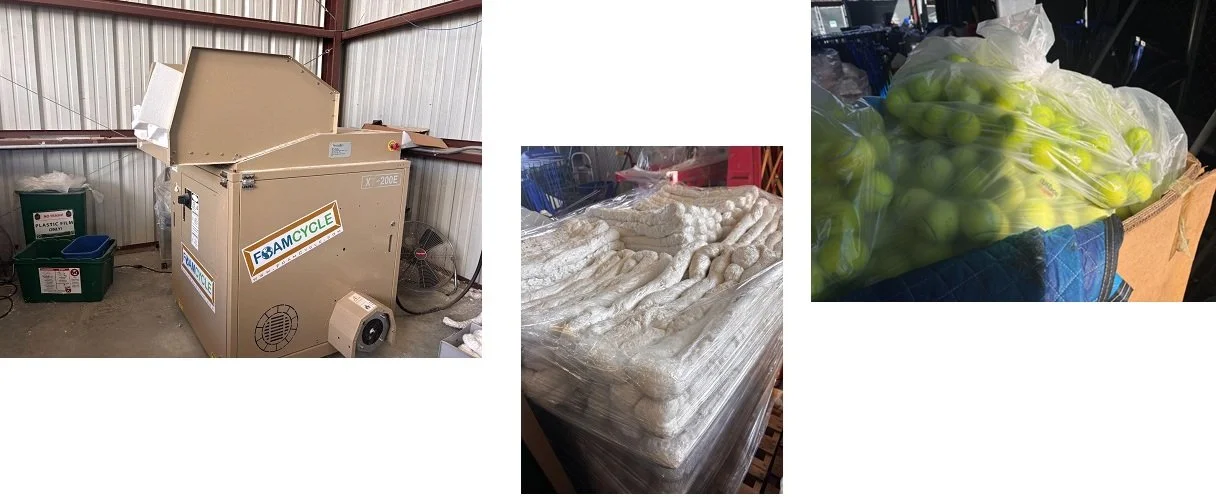
Foam Recycling at UNC Charlotte. Styrofoam is compressed into 45lb bricks, which are used to build tiny homes (Tiny House Community Development of Greensboro) for unhoused or impoverished people.
Tennis balls taken from chair-bottoms in classrooms. These are donated to local animal shelters such as the Cabarrus County Animal shelter for the dogs to have toys.
The zero-waste coordinator position was created so that day-to-day waste management could continue operating smoothly, while long-term planning, such as writing grants, revising contracts, and strategizing next-moves for campus, occurs simultaneously. The zero-waste stadium, paper towel recycling bins in educational buildings and student unions, and more have been made possible thanks to the zero-waste coordinator.
Next, the Office of Sustainability hopes to build a similar role for campus transportation.
Importantly, Dr. Lizotte says: “Almost every Sustainability Office across college campuses runs with a lot of student labor.” Dr. Lizotte says that training and teaching student workers, preparing the next generation of sustainability professionals, is one of the many goals of the sustainability office.
Student workers are analyzing data, making videos, creating graphics, doing creative design and technical engineering projects, teaching faculty and classmates, and more.
Structure and Strategy
When Dr. Lizotte came to UNC Charlotte, he was asked: “How do we get the University to adopt more ‘best practices’ for a school of our size and location?” Upon Dr. Lizotte’s arrival, there was a sustainability plan as well as a climate-action plan.
“Between those two, there were 132 goals,” and no strategic plan that was thinking about them. Strategic clarity was formed through goal prioritization: “22% of the goals were ‘raise awareness about xyz…’” So, during his time at UNCC, Lizotte and his team have focused on sharing information across campus.
“Even today, we frame our sustainability around one question: are we living up to policy?”
UNC Charlotte follows the UNC Board of Governors' sustainability goals (e.g., responsible purchasing, zero-waste), but this policy alignment is self-guided, with no strict external audit or enforcement.
“It’s more of a compliance kind of thing. What that does is it pushes our focus onto the areas where we think we’re falling short.” Where they identify shortfalls, the Sustainability team looks to see how they can make improvements to what already exists, “we look for opportunities to fill gaps in campus sustainability.”
One example of taking a system that already exists, and augmenting it: “In North Carolina, in most of the United States, it’s illegal to put aluminum cans in a landfill. But nobody’s enforcing that, and so Americans put half of their aluminum cans in the landfill.” Dr. Lizotte says, alternatively, if we write a university policy on what to do about aluminum cans on our campus, then we can probably get 95% of them diverted.
“With good supportive signs and available, sorted bins, people wouldn’t throw aluminum cans in the trash.”
Ideally, these efforts at public education by the Sustainability team reinforce social norms on campus, an integral component for ensuring long-term sustainability.
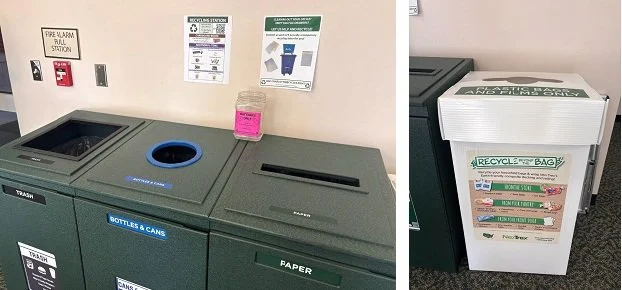
Organized and labeled recycling bins located in campus buildings.
UNC Charlotte also uses LEED goals to formalize campus projects and construction. These campus initiatives require careful planning and a willingness to sift through companies to find those who are doing the best recycling work. “Every couple of years, we’ll demolish a building. And if you go out and get the lowest bid on that job, then somebody will make that building disappear. But if you ask to achieve 75% recycling and diversion on this building demolition, you’ll find companies that are actually capable of doing 98-99%.”
The process goes something like this: The construction workers walk through the building to establish what materials can be diverted, recycled, and/or reused, and what can’t (such as asbestos and some plate glass material), and then they work with the university to establish connections for the flow of waste from the university site.
Dr. Lizotte shared that construction companies can pull the building apart in ways that allow for most materials to go back into the economy.
“In essence, to me, this is what the Office of Sustainability does on a University level: They make sustainability possible by offering campus communities structure, education, and organization. Sustainability workers at public institutions are building community partnerships and awareness so that waste can be recycled, buildings can be greener, and so on.”
Major Sustainability Challenges for Public Universities
Timelines and Construction Work
One of the most challenging aspects of the work: “time or timelines. A lot of people have the wrong impression. They think it’s budget...but I would say far more frequently, what’s happening is the rush.” About his colleagues, Dr. Lizotte tells us, “they would like to have more space to work with [construction] companies to better understand their limitations and challenges.” But, Lizotte says, parking garages, dorms, and learning buildings are under incredible time pressure to accommodate students based on the academic calendar.
This creates conflict between doing the most sustainable thing or meeting deadlines.
Dr. Lizotte offered an example where an alumni recently made a multi-million dollar anonymous donation to build a place for students to gather before football games. The donor had a love for open lawns, stages with good acoustics, and thought it possible that the space could be used as a park or small concert venue when there was no sporting event.
Lizotte tells us, “we had [identified] the space and went into design, and then someone put a timeline on it for the next football season. Then everything gets rushed. And we don’t have time to really consider alternatives.”
Such alternatives may have included: using astroturf for green fields rather than grass, partnering with nearby engineering departments to showcase sustainable engineering concepts like timber-framing and green concrete formulations, and more. Dr. Lizotte said, “there wasn’t time for those, in my perspective, smarter iterations and sustainable choices on things because we’re in a hurry.”
Some of this hustling has to do with the university culture. Lizotte emphasized, “we [UNC Charlotte] also want to build a reputation as somebody who gets things done. So when a donor gives you money, you want to show results fast. So we go automatically to the fast-mode.”
While private colleges, like Duke, can turn their designers and construction teams loose as soon as an idea meets code, Lizotte says public universities face more hurdles.
Waiting for approvals from the state construction office can add even more pressure and delays, while similar projects for private colleges create false-expectations around timelines. Dr. Lizotte says, “a private college in the area does a project in a certain timeline, and you think, ‘Oh! This can be done in that timeline.’ But they don’t have all of the layers of government, and governance that we [public schools] have.” Similar construction hiccups faced by UNC Charlotte have to go “all the way back through Raleigh, and then come back. More people are involved.”
Importantly, Dr. Lizotte emphasized the importance of the State Construction Office: “They find things and save us from creating more problems.” Tension stems from added layers of bureaucracy to sustainable construction work and building practices, especially when timelines take priority.
Another substantial difference is that state entities have a lot of regulations that make it difficult to reject companies or sue them. So, Dr. Lizotte says, “if you’re not a good contractor, you actually want to work for us. Because, in some ways, our hands are tied behind our backs. Whereas the private entity can go get their lawyers and sort things out, with us they might say something like, ‘fine, you get your lawyer–and we’re going to talk to our lobbyist, and we’ll see who gets there first.’ Being part of a larger political organization that can be lobbied can make this really difficult.”
In summary, Dr. Lizotte says, the root of many challenges in the Sustainability Office is as follows:
“As a customer, we come with a whole bunch of rules that are very different from the rules that are in the marketplace.”
Supply and Demand
Another connected challenge for UNC Charlotte’s Sustainability team is a mismatch between supply and demand. Dr. Lizotte says, “some of these challenges [we] face may be sunbelt problems, or rapid growth problems. You run into these problems where, in some areas, we have too many contractors vying for our business,” or, alternatively, not enough.
Organizing the flow of major waste streams is one of the many job responsibilities of the Sustainability Office. Food waste is a major waste source at UNC Charlotte where there are several dining halls and all first-year resident students are required to have a dining plan. According to Dr. Lizotte, “[UNC Charlotte] only has one company, they’re about 35 miles from us, that is big enough to handle our compost at the scale we produce it. The next closest one is 85 miles away.”
A relatively small waste stream at UNC Charlotte is electronic waste, but Dr. Lizotte says there are about a dozen companies inside Charlotte trying to get the Sustainability Office’s business.
“I think in the sunbelt, in the fast-growing cities, there’s just always going to be situations where you have a surplus of contractors in one line of sustainability work, but no experience or contractors in other areas. Those things tend to steer us,” Dr. Lizotte shared.
Looking Forward
Roughly 35,000 people are involved with the UNC Charlotte campus–studying, working, or just visiting. “That makes us basically a small city,” Lizotte says. He mentioned that corporate campuses, sustainable towns, or other cities offer ideas and inspiration to UNC Charlotte. “Corporate campuses also have dining facilities, transportation issues, labs, and learning buildings. We’ve just learned over the last decade how to share ideas across universities.”
Dr. Lizotte says that universities are too used to competing, rather than sharing and collaborating, and that this competition ultimately slows down our collective movement towards a more sustainable planet.
New challenges are constantly surfacing, like: “Electrification of everything.” Right now, UNC Charlotte is playing around with electrification of vehicles, “and that’s small compared to the electrification of the buildings, heating systems, and so on.” Both in terms of environmental impact and investment, electrification will be challenging, especially with these timelines.
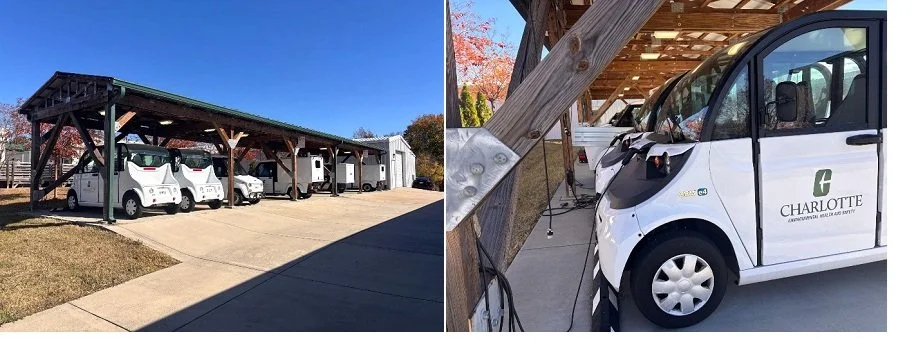
Members of the campus EV fleet getting some well-deserved rest.
“Smart universities are learning how to do this now,” Lizotte says. At some point, the government may step in to regulate these sweeping changes.
For Charlotte, a relatively young public university built in 1946, Dr. Lizotte says, “there’s a lot of potential for changing the transportation footprint, because we’re still building so much around the university. That’s also beginning to create more diverse housing opportunities.”
Universities as Models for Learning
I learned in my “Infusing Sustainability” workshop that university campuses are constantly aligning themselves to regulations aimed at bringing the world closer to achieving goals like the United Nations’ 17 goals for sustainable development. With many thanks to Dr. Mike Lizotte’s service, UNC Charlotte facilities and business offices are constantly finding places to become more sustainable and employee-friendly. Students, faculty, and visitors alike are blending positive messaging with suggestions for sustainability improvement.
While the sustainability office’s work at UNC Charlotte is internal to the university, the Charlotte area and other surrounding universities can learn a lot from them: they focus on partnerships within and between sustainability offices and other local and campus operations, they advocate for the necessary time and resources to make sustainability a priority, they are always coming up with innovative ideas for more sustainable practices, and they go to extraordinary lengths to share their knowledge and expertise with other community members.
Hidden elements of sustainability work like time management, navigating supply and demand complications, and daily equity-economy based action and choices, are just some of the many important things universities are working on to ensure sustainability operations are successful. This paramount work, often happening behind the scenes of universities day-to-day events, is a result of knowledgeable scientists, communicators, and businesspeople's dedication to a more balanced and safe world.
A note of thanks:
Officially, Dr. Mike Lizotte will retire in the Spring of 2026. Dr. Lizotte worked at UNC Charlotte for 12 years, and has worked in sustainability even longer. Without his knowledge and generosity this article could not exist. He is a leader in Charlotte’s Sustainability work, and his wisdom and expertise have served many. Many thanks to Mike for all of his time, kindness, and work.