

Akshata Rangarajan tracks the journey of the term “guru” to its common use in America today, and highlights what she believes to be an important distinction between what’s colloquially meant by the word and the real function of a guru.
She has three hundred thousand followers, a supplement line, a course that unlocks at $497, and a bio that calls her a wellness guru. The morning routine is filmed in natural light. The captions promise clarity, alignment, embodiment. None of it is unusual. Not even her handle: TheBodyMindGuru.
Except it is.
Guru. The word once represented something the marketplace could not manufacture. It meant weight. Gravity. A figure so substantial that time near them changed a person. Somewhere across the long travels of the word, America kept the word and lost what it meant.
The Sanskrit guru is cognate with the Latin gravis and the Greek barys. All three share a Proto-Indo-European root meaning heavy. English keeps the family alive in words like grave, gravity, and gravitas. The guru was one who is heavy, weighty with realization, with substance.
There is a second and older gloss inside the tradition. Gu stands for darkness, for ignorance. Ru for the one who removes it.
Whether one takes this as strict etymology or as devotional interpretation, it has shaped the tradition’s self-understanding for centuries. Both readings point at the same movement of uncovering. What is heavy remains, once ignorance is cleared. Something is removed, and something revealed.
To sit with a guru was to sit with someone whose work was to clear what stood in your way.
Let’s journey back three thousand years ago to the northern plains of India. A young man named Shvetaketu returned home after twelve years of studying the Vedas, the foundational texts of ancient Indian philosophy and life. He was proud of what he knew. His father, Uddalaka, was himself a teacher of the Vedas, a guru.
Seeing his son beaming with pride, Uddalaka asked him one question.
“Did you ask for the teaching by which the unheard becomes heard, the unthought thought, the unknown known?”
The boy had no answer. He had learned much and asked little.
Uddalaka did not lecture in return. The next morning he called for a lump of salt and a bowl of water. He told the boy to place the salt in the water and return in the morning. The boy returned the next day. Uddalaka asked him to bring the salt back. The boy looked. The salt was gone. He put his hand into the water and searched. Nothing.
Uddalaka told him to taste from one side of the bowl. Salt. From the middle. Salt. From the other side. Salt.
Then Uddalaka spoke.
“You could not see it, but it was here the whole time. In this way, the same Reality pervades everything. Invisible. Present in every part. You have not been able to see it. It is here, and it is what you are.”
The boy had recited this teaching for twelve years. He had memorized every verse of the Vedas that pointed at it. But it had remained just that – memorized information. Uddalaka did not give him more information. He provided grounds for understanding.
This is what a guru was, and this is the world the word came from. A person who arranged the question, the object, and the silence in which the student could taste what he already carried.
The concept of the guru did not thin over the next twenty-five centuries. It compounded.
Buddhist teachers transmitted teachings monk to monk, mind to mind, in unbroken lines. Sufi masters across Persia and Central Asia called their students murid, seekers, and the students called them murshid, guide. A near mirror of the same relationship in a different tongue.
In the Punjab in the fifteenth century, Guru Nanak founded a new religion around the word itself. Nine gurus followed him in succession. When the tenth died in 1708, no living teacher took his place. The scripture became the eternal guru, called the Guru Granth Sahib, . A book heavy enough to teach.
Across every tradition, the movement was the same. The teacher arranged the conditions in which the student could see what was already there but obscured. Nothing added. Nothing sold.
The word did not arrive in America directly.
It made a long trip. It entered English in 1613 through a cleric compiling travel writing about India, and for three hundred years it stayed a specialist term. Then in the mid-1960s, the word left the temple. Marshall McLuhan, a Canadian professor and author of Understanding Media, was branded as a media guru as a part of the PR campaign that made him a household name. The word stuck and began a new life.
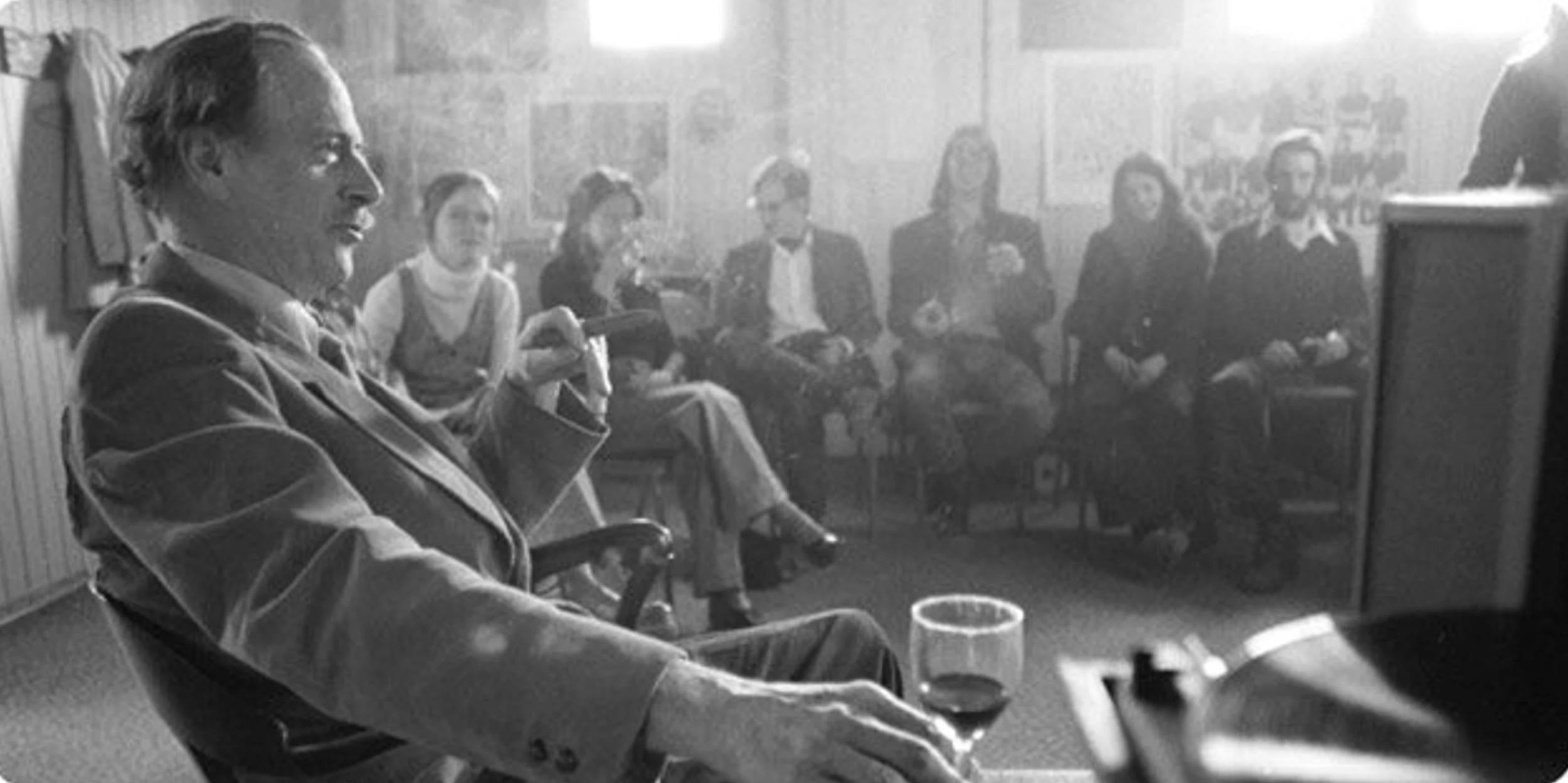
Marshall McLuhan
By 1968 the Beatles were sitting at the feet of a teacher in Rishikesh, and a generation of young Westerners followed. Some found something real. Many did not.
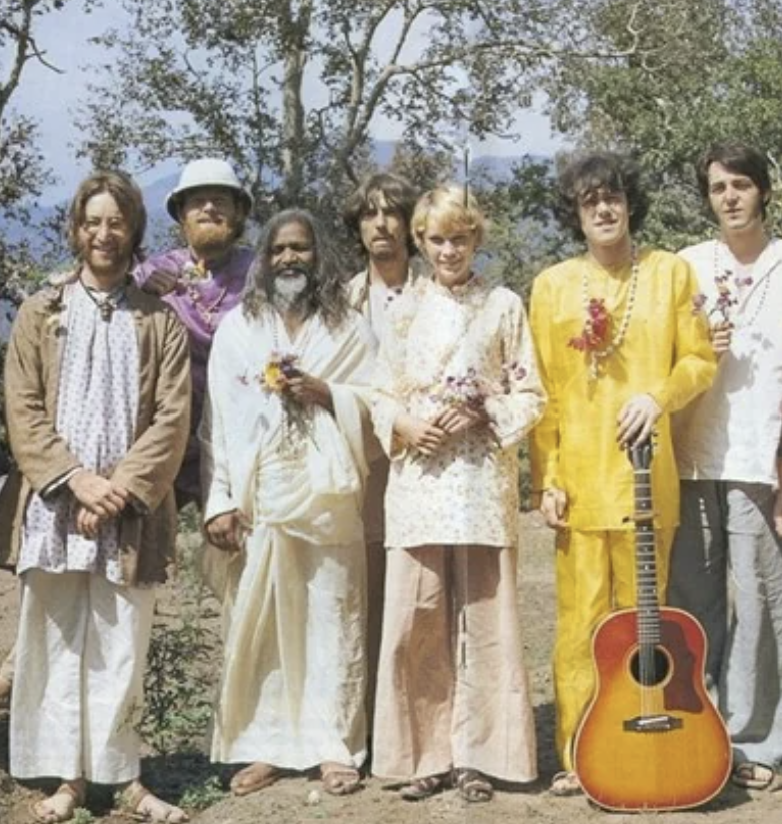
Left to right: John, Mike, Maharishi Mahesh Yogi, George, Mia Farrow, Donovan and Paul
By the seventies, some of those teachers had followed their students west, building communes on American soil. A few of them ended in scandal. The cult documentaries that came in the decades after did the rest.
Each wave changed what Americans heard when they heard the word. What arrived as a term of reverence exited as a term of suspicion, and then as a term of marketing. A wellness guru today is downstream of all of it.
What was imported was the word, without its discipline:
The twelve-year residency at a gurukula, the teacher who withheld the transmission until the student had become the kind of person who could receive it, the deferred exchange that made pricing transformation impossible in advance.
The Wes Anderson ashram and the Elizabeth Gilbert year abroad kept the aesthetic. The gravity stayed behind.
The American “guru” is light in the exact sense the original was heavy. It adds where the original subtracted.
It charges up front for what the tradition would only accept once the work was done, once the student had become the kind of person who could recognize what the teaching had been worth. The offering had a name.
Guru-dakshina.
Its timing implied the whole philosophy. You could not price transformation in advance. You could only look back and give what the receiving deserved.
Its function, quietly at work
In 1974, a nineteen-year-old college dropout named Steve Jobs traveled to India with a friend to meet a saint called Neem Karoli Baba at his ashram in Kainchi Dham, in the foothills of the Himalayas. By the time they arrived, Baba had died the previous September. Jobs stayed anyway. He wore khadi, ate dal and rice, walked the grounds, and sat with what remained of the teaching in the disciples the guru had left behind.
What he brought back was subtractive in every direction. Fewer buttons. Fewer settings. Fewer decisions asked of the user. Simplicity, he would later say, is the ultimate sophistication. The most valuable company in the world was built on the discovery that people would pay more for what had been taken away than for what had been added. The design language of a century began at a dead guru’s ashram.

Photo credit: Paul Sakuma
In 1972, a twice-divorced mother of two in New York read a single article by a Tibetan teacher named Chögyam Trungpa. Something in her reorganized. She began to study, took refuge vows, and in 1981 was ordained as a Buddhist nun under the name Pema Chödrön. Her books, especially When Things Fall Apart, have sold in the millions.
Her teaching in America has been, for forty years, a single subtractive move: stop adding resistance to what is already there. Do not medicate the pain, do not distract from it, do not fix it. Turn toward it.
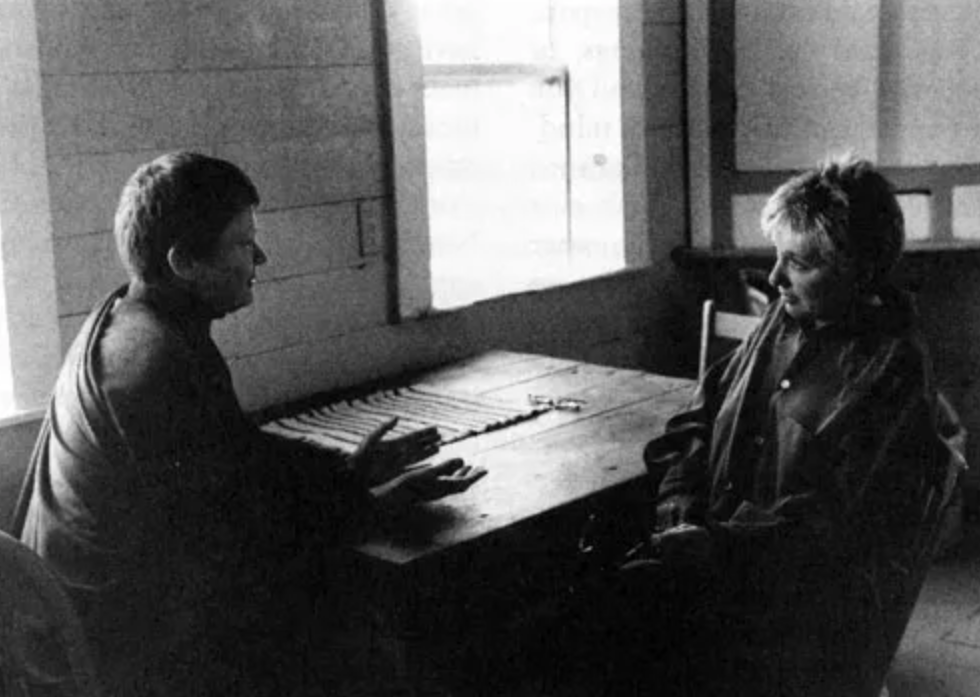
Photo credit: Jeri Coppola
Every wellness guru sells an addition. Pema Chödrön has spent a lifetime asking Americans to remove one thing, the reflex to escape what is already true. That is Uddalaka’s move. That is what the tradition meant by clearing the darkness.
In 1977, a fourteen-year-old boy from Long Island named Rick Rubin was prescribed meditation by his pediatrician for stress-related neck pain. The practice was Transcendental Meditation, brought west by Maharishi Mahesh Yogi, the same Indian teacher the Beatles had studied with at Rishikesh nine years earlier. Rubin has practiced it for nearly fifty years and calls it the most important thing he has ever done.
What he took from it was a single principle: remove until only the essential remains. He calls himself a reducer, not a producer, and his instruction to every artist is: reduce until identity is challenged. He walked Johnny Cash into a room with one guitar and produced the most celebrated late-career revival in American music. He told Kanye to take songs off Yeezus, not add them.
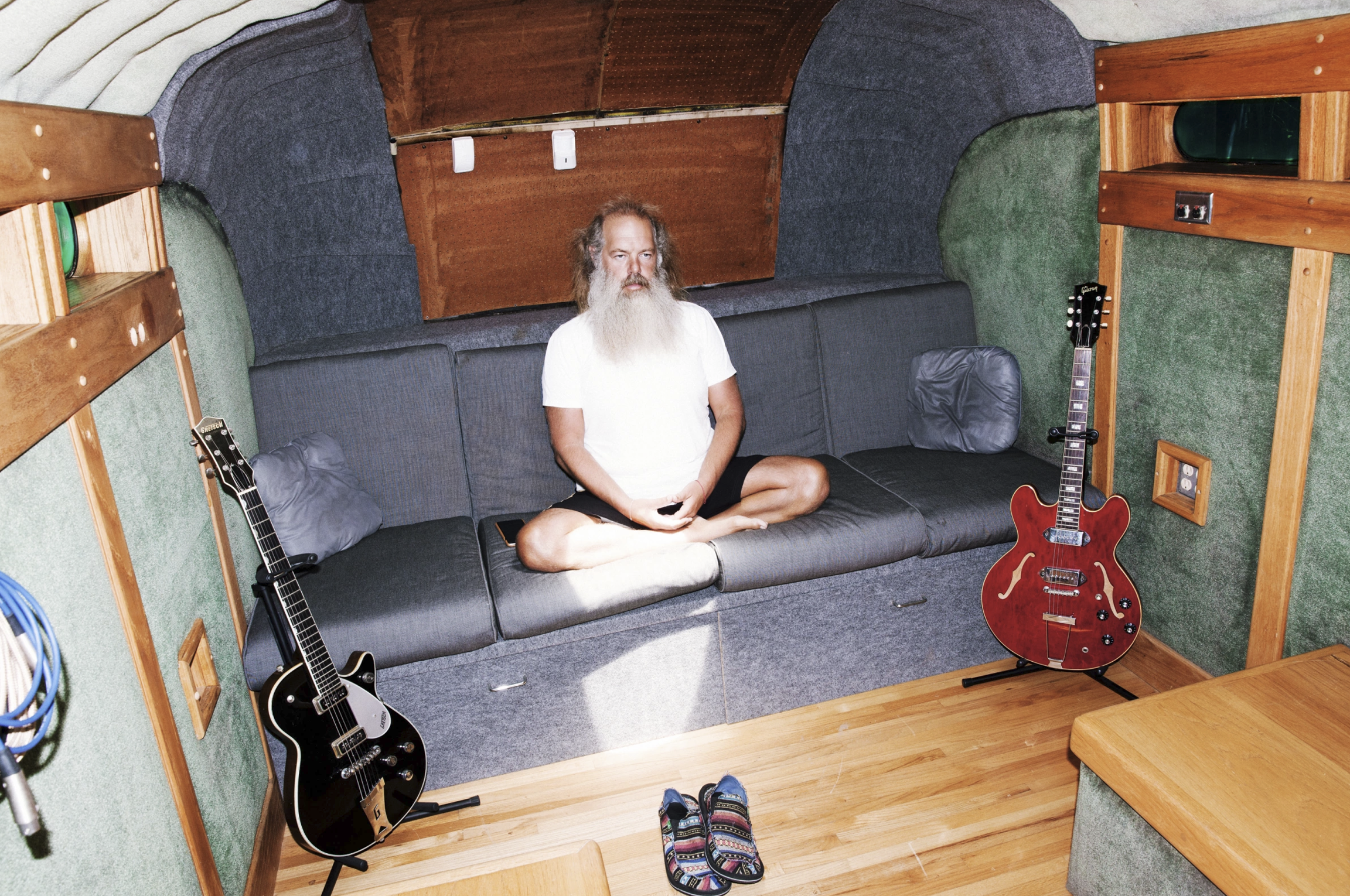
Photo credit: Bryan Sheffield
Three encounters, three domains, one method. None of them proclaimed themselves guru.
The concept the word once carried has been quietly at work in parts of American life the country most admires. In design. In contemplative teaching. In music.
In each case, the same movement. Something was removed. What remained was what mattered.
The counter-case is easy to find.
The financial press has spent twenty years calling Jim Cramer a stock guru. His show Mad Money is the additive stance made theater. Dozens of stock picks per episode, sound effects, theatrical urgency, a lightning round.
The record of the calls is public. In August of 2008, weeks before the financial crisis climaxed, he recommended Bear Stearns, Merrill Lynch, Morgan Stanley, Wachovia, and Lehman Brothers. Within months, several of those companies ceased to exist.
The most watched money guru on American television has been, for two decades, additive noise sold as insight.
The contrast is the whole argument. Some did the work of the guru without the label. Subtraction built the design language of the era, produced the meditation classics of a generation, and shaped the sound of American music for forty years. Others wore the label and muddied the work.
The wellness guru with three hundred thousand followers is selling addition, and the market for it will remain enormous. But something is quietly being lost, and most of us can feel it without being able to name it.
A twenty-nine year old tracking sleep score, heart rate variability, macros, workouts, meditation minutes, journal streaks, and screen time, and reporting that she is more anxious than she was before she started.
A reading list of fifteen career books, three finance podcasts on 2x speed, and a therapist and a coach and an app, and no clearer sense of what to do next than there was a year ago. A browser with thirty tabs open, an inbox with five hundred unread, a task list that grows faster than it shrinks.
This is what accumulation does. It produces noise, confusion, decision fatigue, and the specific exhaustion of a mind that has been given more inputs than it can metabolize.
The guru function is the opposite move. It removes.
The function of a guru is to uncover the actual question, and then strip away everything that is not that question. This is what the twenty-nine year old is actually looking for when she adds the eighth tracker. It is what the reader of the fifteenth career book is trying to reach when she buys the sixteenth. The instinct is right. The direction is wrong. Adding more will not deliver what only removal can produce.
The value is not mystical. It is measurable. It shows up as decisions made faster, sleep that actually restores, a mind less crowded by things that did not need to be there.
It does not necessarily mean sitting in an ashram. It does not mean rejecting the market either. The tradition never asked that. Chanakya was a guru and the sharpest political economist of his age. He wrote the Arthashastra, a treatise on statecraft, taxation, and trade that is still read today.
The guru function and the material world were never at war inside the tradition. What was refused was the collapse of one into the other. In America, the market took preference at the expense of the guru function, and we now suffer the lack of something that could greatly enhance our lives.
Reclaim the guru.
The word, as used in America, and the function it was originally intended to name have come apart. When the label “guru” appears without the function of a guru, the word itself has been hollowed.
The people wearing the label rarely do the work. The people doing the work rarely wear the label.
What we need to reclaim is the intellectual capacity to separate the label “guru” from its function and recognize the hollowed word. We can restore the word to represent the weight it actually carries, one conscious decision at a time.
Some people, practices, and encounters add. Others remove. The tradition asked you to know the difference and to spend your attention accordingly.
Next time you’re trying to assess something or someone being called a guru, two questions do this work:
Does this add weight, or noise?
Does this remove darkness or produce it?
You just might stand to gain that coveted sense of joyful resolution, of clarity, of light.